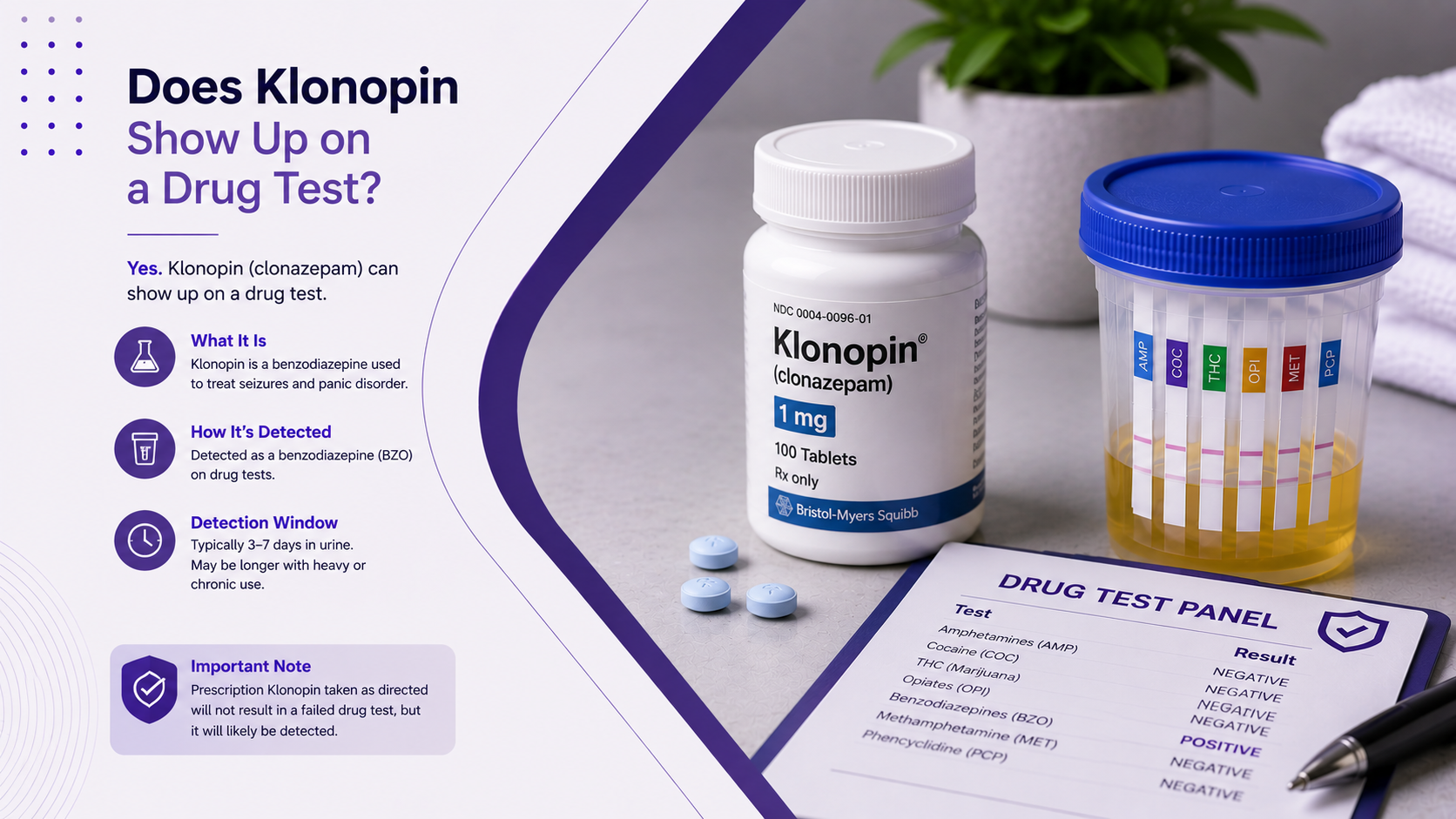
Does Klonopin show up on a drug test? Yes, it can. Klonopin is the brand name for clonazepam. Clonazepam is a prescription drug in the benzodiazepines class. It may be used for panic disorder, panic attacks, and seizure disorders. Since Klonopin is a long acting benzodiazepine, it can stay in someone’s system longer than some other benzodiazepines. A drug test may look for benzodiazepines, but not every drug test finds Klonopin the same way. Some urine drug screens may miss clonazepam, which can lead to a false negative. Other drug tests may show a positive result and need lab review.
Lynk Diagnostics helps rehab facilities use clear drug testing methods so test results are easier to understand.
What Is Klonopin?
Klonopin is a central nervous system depressant. This means it slows activity in the brain and body. Doctors may prescribe Klonopin for panic disorder, panic attacks, or seizure disorders. The specific drug inside Klonopin is clonazepam. Clonazepam use can help some people when taken as prescribed, but it also has risks. Klonopin use may lead to physical dependence, especially with higher doses or long-term use. Stopping abruptly can cause withdrawal symptoms, and in some cases, severe symptoms may need help from an emergency department. Klonopin can also be risky when mixed with other drugs, sleeping pills, muscle relaxants, alcohol, or other substances. Combining Klonopin with these substances can raise the risk of respiratory depression, low blood pressure, confusion, and overdose.
How Drug Testing Looks for Klonopin
Drug testing can use urine, blood, saliva, or hair. The most common choice is urine. A urine test is often used because it is simple, fast, and less costly. Urine drug tests and urine drug screens may look for benzodiazepines as a drug class. But Klonopin is different from certain benzodiazepines because the body breaks clonazepam down into metabolites that some tests do not catch well. This is why a drug screen may not always match real benzodiazepine use. Some urine drug screens may show a positive result. Others may show a false negative, even when someone took Klonopin. When test results matter for addiction treatment, medical care, or rehab monitoring, a lab confirmation test is often needed.
Why Klonopin Can Be Missed on Some Tests
Klonopin detection can be tricky. Many urine drug screens are immunoassay tests. These drug tests are made to find common medicines or many drugs in a class. But they may not be sensitive to clonazepam. This can cause a false negative. A false negative means the test says the drug was not found, even though the substance may be in someone’s system. False negative results may happen because of the test type, the cutoff level, the last dose, a low dose, slower metabolism, urine dilution, or individual differences. Other factors like body mass, body mass index, liver function, hydration, and timing can also affect drug detection times.
False Positive and False Negative Results
A false positive means a test says a drug is present when it is not. A false positive result can happen with some drug testing methods because some common medicines may look alike to the test. False positive results may also happen due to cross-reactivity, lab error, or sample mix-ups. A false positive may be stressful for a person in addiction treatment, a workplace program, or a rehab facility. A false negative can also be a problem because it may hide real drug use. False negative results are possible with Klonopin because some tests do not detect clonazepam well. This is why Lynk Diagnostics supports careful testing, review, and confirmation. A positive result, false positive, false positive result, false positive results, or false negative should not be judged without the full picture.
How Long Does Klonopin Stay in Someone’s System?
How long Klonopin stay times last can vary depending on many things. Klonopin has a long half life. A half life is the time it takes for the body to remove about half of a drug. Because Klonopin has a long half life, Klonopin stay times can be longer than some other benzodiazepines. In general, clonazepam may be found in urine for several days, and sometimes longer. Klonopin stay depends on the last dose, dose size, how often the person takes it, body mass, slower metabolism, age, health, and individual factors. Higher doses may lead to longer Klonopin detection. A low dose may clear faster. But drug detection times are not the same for each person.
Detection Window by Test Type
A detection window is the time a test may find a drug in someone’s system. A urine test may find clonazepam metabolites for several days or more. Urine drug tests are common in rehab and treatment settings. A blood test may show more recent use, but it has a shorter detection window than urine in many cases. Hair testing may look back farther, but it is not always used for routine Klonopin detection. Drug testing results vary depending on the test, the lab, the cutoff, and the person. Therapeutic drug monitoring may be used in medical care when doctors need to check drug levels for safety. In rehab settings, drug testing is often used to support care, accountability, and safety.
Why Confirmation Testing Matters
A basic drug screen can give fast results, but it may not give the final answer. If a person may test positive, or if unexpected results appear, confirmation testing can help. Gas chromatography mass spectrometry is one type of advanced lab testing used to confirm a specific drug or substance. This type of test can help tell the difference between clonazepam, other benzodiazepines, designer drugs, synthetic cannabinoids, and other drugs. It can also help lower the chance of a false positive or false negative. Lynk Diagnostics works with rehab facilities that need reliable drug testing, clear reporting, and support for interpreting drug test results.
Klonopin, Substance Abuse, and Addiction Treatment
Klonopin is a legal prescription drug, but it can still be misused. Substance abuse may happen when someone takes Klonopin without a prescription, takes higher doses than prescribed, mixes it with other drugs, or uses it to get high. Drug abuse involving benzodiazepines can be dangerous. Benzodiazepines may cause sleepiness, poor balance, memory problems, and slowed breathing. Physical dependence can happen even when a person takes Klonopin as directed for a long time. Addiction treatment teams may use drug testing to watch for benzodiazepine use, other substances, and relapse risk. Lynk Diagnostics is a drug testing center dedicated to rehab facility needs, helping care teams make safer choices with better test information.
Factors That Affect Klonopin Detection
Klonopin detection can vary depending on individual factors. These include the person’s age, body mass index, body mass, kidney health, liver health, hydration, dose, and how often Klonopin is used. A person with slower metabolism may have Klonopin stay in their body longer. A person who took the last dose recently may be more likely to test positive. Someone who uses benzodiazepines with other substances may also have different results. Other factors include the type of urine drug test, the cutoff level, and whether the lab checks for clonazepam metabolites. Most benzodiazepines are not processed in the exact same way, so certain benzodiazepines may be easier to find than Klonopin.
Medicines and Foods That Can Affect Results
Many drugs, common medicines, and even foods can affect drug testing in some cases. Some people worry about poppy seeds because they may affect opioid testing, not Klonopin testing. A selective serotonin reuptake inhibitor may also be discussed when reviewing a false positive, because some medicines can cause cross-reactivity on certain tests. Sleeping pills, muscle relaxants, and other benzodiazepines may also matter when reviewing a drug test. Synthetic cannabinoids and designer drugs may require special testing because standard drug tests may not detect them. A urine sample should always be reviewed with the person’s medication list, medical history, and test method.
What Rehab Facilities Should Know
Rehab facilities need drug testing that is fair, clear, and useful. A single drug screen should not be the only source of truth. Test results should be reviewed with clinical notes, prescription records, symptoms, and behavior. If a urine drug screen gives a positive result, it may need confirmation. If urine drug screens show a false negative, the care team may need a better test. Lynk Diagnostics helps rehab teams understand drug testing for Klonopin, clonazepam, benzodiazepines, other drugs, and other substances. This helps reduce confusion and supports better care for people in addiction treatment.
Trusted Information and Medical Review
Sources like the National Institute on Drug Abuse, National Center for Biotechnology Information, Rochester Medical Center, American Addiction Centers, and medical journals such as J Anal Toxicol discuss drug use, benzodiazepines, testing limits, and substance risks.
American Addiction Centers also explains that benzodiazepines can be misused and may need professional care. American Addiction Centers notes that withdrawal from benzodiazepines can be serious. American Addiction Centers and other medical sources often stress that people should not stop benzodiazepines suddenly without medical help. American Addiction Centers, the National Institute, and Rochester Medical Center are examples of organizations people may read when learning about drug testing and addiction risks.
Lynk Diagnostics uses this type of medical understanding to support responsible drug testing for rehab facilities.
When to Seek Help
A person should seek help if Klonopin use feels hard to control, if they mix Klonopin with alcohol or other drugs, or if they have withdrawal symptoms. Warning signs may include strong cravings, memory problems, extreme sleepiness, confusion, breathing problems, or suicidal ideation. Benzodiazepines can be helpful when used correctly, but misuse can be dangerous. If someone has severe symptoms, trouble breathing, or signs of overdose, call emergency services right away. For ongoing drug use concerns, addiction treatment can help. Drug testing is not meant to shame people. It is meant to support safety, honesty, and care.
FAQs
Does Klonopin always show up on urine drug tests?
No. Klonopin may show up on urine drug tests, but some urine drug screens may miss it. This can cause a false negative. Confirmation testing may be needed.
Can Klonopin cause a false positive?
Klonopin itself is a benzodiazepine, so a benzodiazepine positive result may be expected if the test detects it. A false positive can still happen with drug testing, so lab confirmation is important.
How long does Klonopin stay in someone’s system?
Klonopin stay times vary depending on dose, last dose, half life, body mass, slower metabolism, and individual factors. It may be found in urine for several days or longer.
What test is best for Klonopin detection?
A lab confirmation test is often better than a basic drug screen. Gas chromatography mass spectrometry or similar confirmatory testing can help identify clonazepam more clearly.
Why do rehab facilities use drug testing for Klonopin?
Rehab facilities use drug testing to support safety, track benzodiazepine use, review other drugs, and guide addiction treatment. Lynk Diagnostics helps make this process clearer and more reliable.
Resources