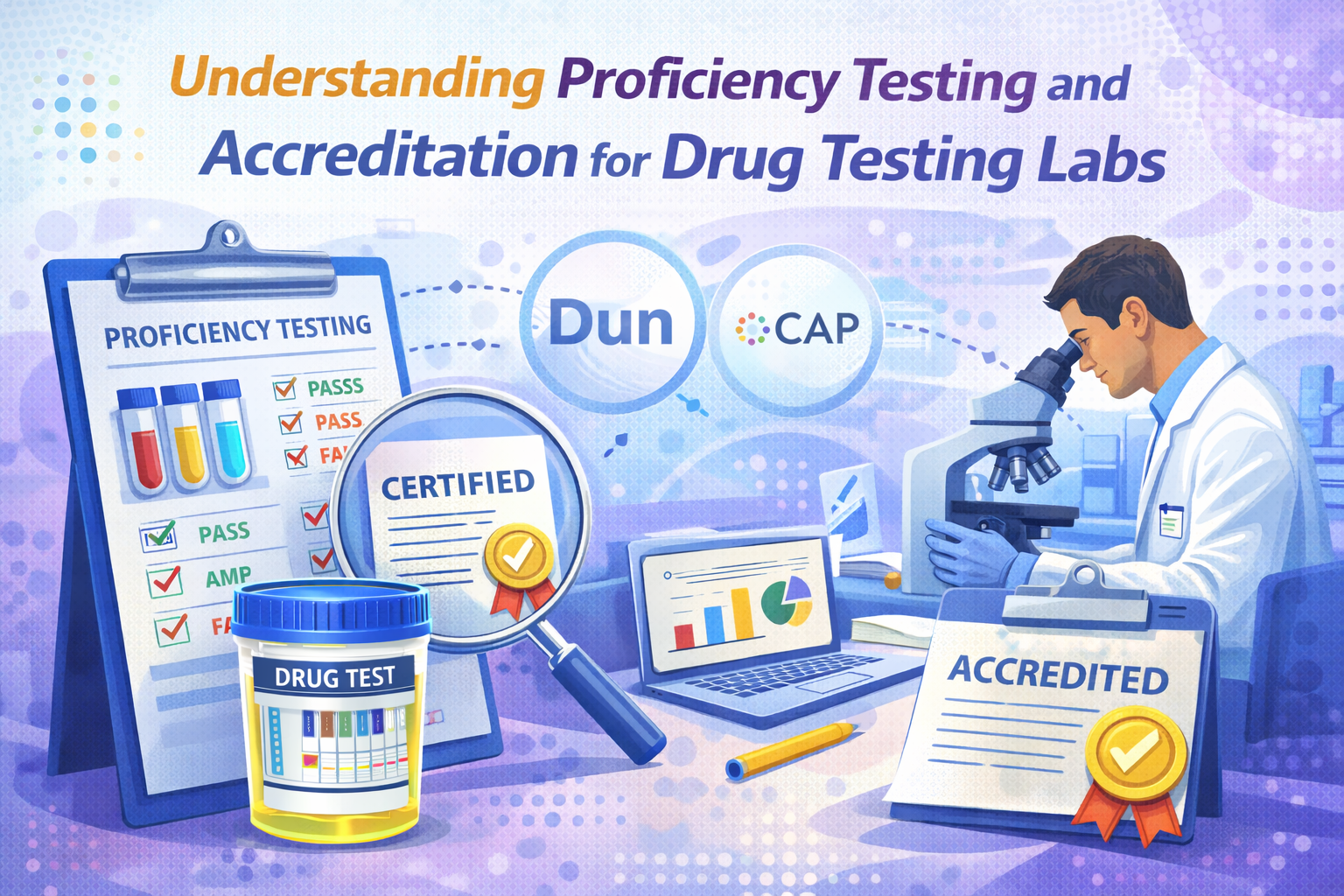
Understanding Proficiency Testing and Accreditation for Drug Testing Labs
Understanding proficiency testing and accreditation for drug testing labs is very important for rehab facilities, healthcare providers, and patients. Drug testing helps guide care decisions. It affects treatment plans, safety, and trust. Because of this, labs must follow strict rules and high standards.
At Lynk Diagnostics, a drug testing center dedicated to rehab facilities, quality and accuracy come first. When labs use strong quality assurance systems, they protect patient safety and provide reliable data that doctors and clinicians can trust.
In this guide, we will explain what proficiency testing is, what accreditation means, and why both matter for drug testing labs.
What Is Proficiency Testing?
Proficiency testing is a way to check if a laboratory can correctly test and report results. It acts like a “test for the lab.”
An outside agency sends unknown samples to the lab. These samples may contain a drug or may be drug-free. The lab performs the same assay procedures it uses for real patient samples. Then it reports the results back.
The agency reviews the answers. If the lab reports correct results, it passes. If not, the lab must fix the problem.
Why Proficiency Testing Matters
Proficiency testing helps ensure:
- Accurate drug detection
- Reliable patient results
- Strong quality assurance systems
- Trust in lab data
- Compliance with healthcare regulations
Without proficiency testing, labs may not know if something in their process is wrong. Even small errors in an assay can lead to incorrect results. That can affect patient care in rehab programs.
What Is Accreditation for Drug Testing Labs?
Accreditation means that a lab has been officially reviewed and approved by a recognized organization. The lab must prove it follows strict standards for testing, reporting, safety, and data handling.
Accreditation is not just a one-time event. Labs must:
- Maintain proper documentation
- Follow approved assay procedures
- Train staff regularly
- Protect patient information
- Participate in proficiency testing
When a lab is accredited, it shows that it meets national and industry standards.
How Proficiency Testing and Accreditation Work Together
Proficiency testing and accreditation are closely linked. You cannot have strong accreditation without ongoing proficiency testing.
Think of accreditation as the big picture review. It checks the lab’s systems, policies, and quality assurance plan. Proficiency testing checks daily performance and technical accuracy.
Together, they protect:
- Patient safety
- Clinical decision-making
- Legal compliance
- Rehab facility credibility
At Lynk Diagnostics, these systems work together to ensure accurate drug testing for rehab partners.
The Role of Assay in Drug Testing Accuracy
An assay is the scientific test used to detect a drug in a sample. It may be used for urine, blood, saliva, or other specimens.
If an assay is not working correctly, results may be wrong. That is why proficiency testing checks assay performance.
Accredited labs must:
- Validate each assay
- Monitor performance daily
- Review quality control data
- Document every step
In drug testing labs, accuracy is critical. A wrong result can impact a patient’s treatment plan in rehab. It can also affect trust between the patient and care team.
Why Drug Testing Quality Assurance Is Critical
Quality assurance is a system that ensures every step of testing meets high standards. It includes:
- Staff training
- Equipment maintenance
- Data review
- Internal audits
- Proficiency testing participation
Strong quality assurance reduces mistakes. It improves reliability. It protects both the patient and the rehab facility.
In pathology and laboratory medicine, quality assurance is not optional. It is required for patient safety.
The Importance of Accurate Data in Drug Testing
Drug testing produces data. This data helps healthcare providers make decisions.
If the data is wrong, the decision may also be wrong.
For example:
- A false positive drug result could change a patient’s treatment plan.
- A false negative could miss a relapse risk.
That is why accreditation standards require strict data controls. Labs must:
- Track samples carefully
- Secure digital records
- Review reports before release
- Correct errors quickly
At Lynk Diagnostics, protecting drug testing data is a top priority.
How Accreditation Protects Rehab Facilities
Rehab facilities depend on reliable drug testing results. If a lab is not accredited, the facility may face:
- Legal risks
- Compliance problems
- Loss of trust
- Poor patient outcomes
Accredited labs show that they meet accepted healthcare and pathology standards. This helps rehab programs demonstrate compliance and professionalism.
For rehab leaders, choosing an accredited drug testing partner is a smart risk management decision.
Regulatory Oversight and Compliance
Drug testing labs operate under strict regulations. These standards are set by government and healthcare agencies.
Accreditation bodies review:
- Laboratory procedures
- Staff qualifications
- Equipment calibration
- Quality assurance programs
- Proficiency testing results
Failure to comply can lead to penalties or loss of certification.
By participating in regular proficiency testing and maintaining accreditation, labs show they are committed to ethical and accurate drug testing practices.
How Often Do Labs Perform Proficiency Testing?
Most accredited drug testing labs must complete proficiency testing multiple times per year. The frequency depends on regulations and the types of assays performed.
Each round tests different drugs and scenarios. This ensures:
- Ongoing competency
- Detection of new issues
- Continuous improvement
It is not enough to pass once. Labs must show consistent performance over time.
Common Problems Found Through Proficiency Testing
Proficiency testing helps identify issues such as:
- Instrument calibration errors
- Sample mix-ups
- Assay sensitivity problems
- Data entry mistakes
- Staff training gaps
When a lab finds a problem, it must take corrective action. This may include retraining staff or adjusting procedures.
This process strengthens quality assurance and improves patient safety.
The Patient Impact of Accurate Drug Testing
Behind every test result is a real patient.
Drug testing in rehab settings helps:
- Monitor treatment progress
- Support recovery
- Ensure medication safety
- Detect relapse early
If results are inaccurate, patient care can suffer. That is why proficiency testing and accreditation matter so much.
They are not just technical requirements. They protect real people.
How Lynk Diagnostics Supports Rehab Facilities
Lynk Diagnostics is dedicated to supporting rehab facilities with reliable drug testing services.
By focusing on:
- Strong quality assurance systems
- Ongoing proficiency testing
- Secure data handling
- Accurate assay performance
Lynk Diagnostics helps ensure that every drug test supports better patient outcomes.
Rehab facilities can feel confident knowing their lab partner values accuracy, compliance, and integrity.
Choosing the Right Drug Testing Lab
When selecting a drug testing lab, ask:
- Is the lab accredited?
- Does it participate in regular proficiency testing?
- How does it protect patient data?
- What quality assurance measures are in place?
- How are assay methods validated?
The answers to these questions help protect your patients and your organization.
FAQs
What is proficiency testing in drug testing labs?
Proficiency testing is a process where a lab tests unknown samples to prove it can correctly detect a drug. It checks the lab’s accuracy and quality assurance systems.
Why is accreditation important for drug testing labs?
Accreditation shows that a lab meets national standards for testing, data handling, and patient safety. It helps ensure reliable results.
How does proficiency testing protect patients?
Proficiency testing ensures that drug assay results are accurate. Accurate results help doctors make safe treatment decisions for each patient.
What role does quality assurance play in drug testing?
Quality assurance includes policies and procedures that reduce errors. It covers staff training, equipment checks, and data review to ensure reliable results.
How often should drug testing labs complete proficiency testing?
Most accredited labs complete proficiency testing several times each year. Regular testing ensures continued accuracy and compliance.
Resources
- Centers for Medicare & Medicaid Services (CLIA):
https://www.cms.gov/Regulations-and-Guidance/Legislation/CLIA - U.S. Food and Drug Administration (FDA) – Laboratory Testing:
https://www.fda.gov/medical-devices/vitro-diagnostics - Centers for Disease Control and Prevention (CDC) – Laboratory Quality:
https://www.cdc.gov/labquality - National Library of Medicine – Clinical and Forensic Toxicology:
https://www.nlm.nih.gov
Understanding proficiency testing and accreditation for drug testing labs is essential for protecting patient safety and maintaining trust in rehab settings. When labs follow strong quality assurance standards, monitor assay performance, and protect sensitive data, they support better outcomes for every patient.